
Compare Porter County Property Value Types
A Porter County property value means little without its source and date. XSoft keeps valuation information apart from sales information. A deed may state consideration. The Treasurer shows what was billed or remains due. Keep each figure in its own column rather than melting them into a single estimate of what a property is worth.
| Value | What It Is | Where |
|---|---|---|
| Assessed value | The assessment amount for the displayed roll and year | XSoft Valuation List |
| Market value in use | Indiana's assessment standard for the property's current use | Assessor records and DLGF guidance |
| Last sale or transfer entry | A sale shown in the assessment system, subject to context and completeness | XSoft Sales or Transfer History |
| Recorded consideration | An amount stated in a deed or transfer instrument when present | Recorder image or copy |
| Taxable or bill amount | A tax calculation affected by deductions, rates, and charges | Treasurer account and bill |
Indiana's assessment standard is market value in use. Ratio studies and trending keep the roll uniform across parcels. Even so, that standard does not convert an assessment into a sale appraisal, because a recent transfer may involve foreclosure, a tax sale, or a family transaction. A price from a distressed or unusual sale makes a poor comparison for any other property.
Porter County XSoft Separates Value and Sale Records
The Porter County Assessor's XSoft portal takes an owner, an address, or a property number, and a result row lists Property ID, Owner Name, Address, City, Map, Detail, and Services. The detail navigation splits from there. Valuation List, Sales List, Transfer History, Taxes, Land Info, and Improvement Info each sit on their own screen. The layout keeps value apart from sales.
| Portal field or view | What to capture | Why it matters |
|---|---|---|
| Property ID or parcel number | The exact identifier with zeros and punctuation | Keeps values tied to the right land |
| Valuation List | Assessment amount and displayed year | Shows which roll the value belongs to |
| Land and Improvement Info | Separate land and structure context | Explains components behind the total |
| Sales List or Transfer History | Date, amount, and transaction clues shown | Provides a comparison, not a guaranteed market price |
The portal posts an accuracy and completeness warning. It also displays a current-as-of date. Keep that date attached to any value you copy, since no single card view reliably combines mailing address, situs, last sale, and current owner in one place.
View a Porter County Assessment Result
The XSoft sample parcel result is the official example.
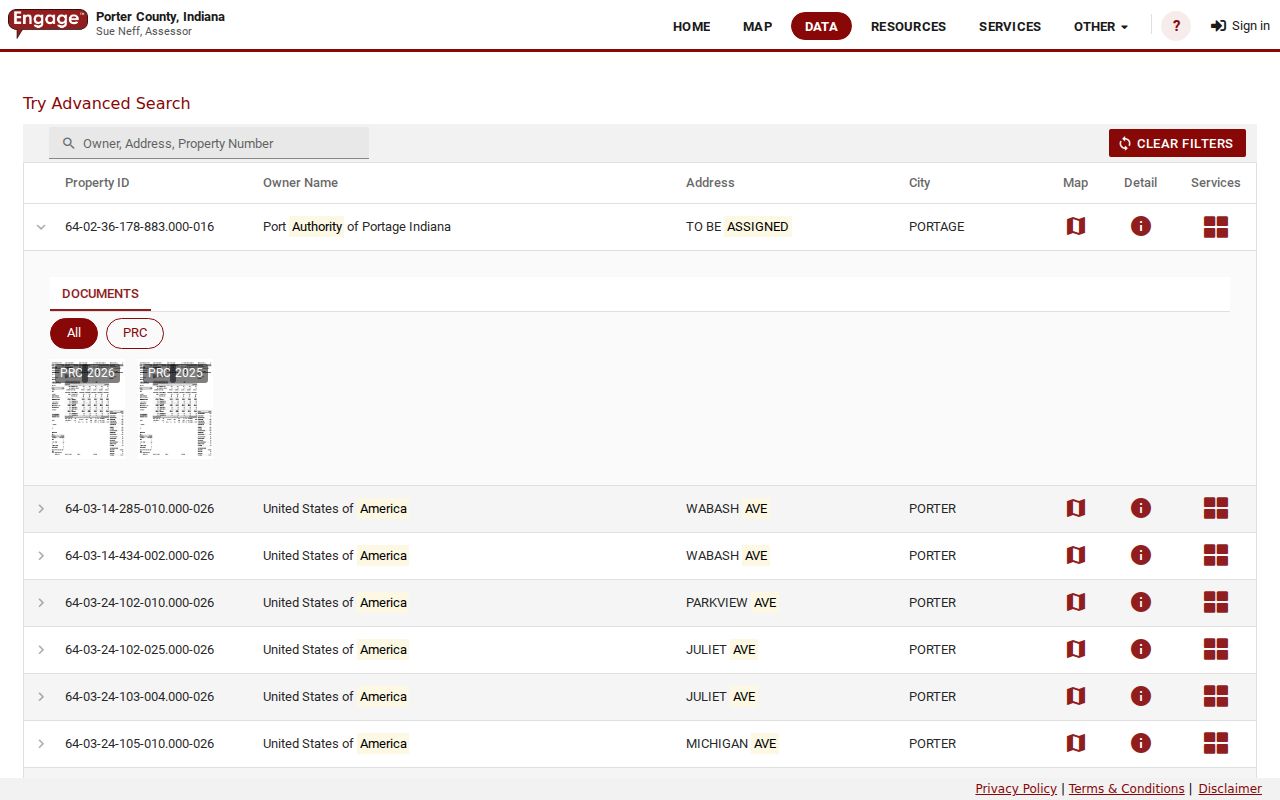
The row ties a State Number, address, owner label, valuation context, city, and property class together. It is a sample display only.
Find a Porter County Property Value by Address
Start with the address, but let the parcel number serve as the durable bridge between systems. XSoft needs at least three letters for suggestions. When an address fails, simplify the unit or direction, test the street name, or open the GIS map to recover the parcel identifier. The parcel number, not the address, travels cleanly.
- Search XSoft by address and confirm the Property ID, parcel number, city, and map position.
- Open Valuation List and record the assessment year, land component, improvement component, and total shown.
- Open Sales List and Transfer History, keeping each date and amount separate from the assessment.
- Use the Recorder image when recorded consideration or transfer terms are needed, then note any distress context.
- Assessed value
- The value assigned on the assessment roll for its stated year.
- Market value in use
- Indiana's value standard based on how property is used, applied through mass assessment.
- Assessment ratio
- A comparison used in ratio studies to test assessed values against qualifying sales.
- Sale or consideration price
- A transaction amount that may appear in sales data or a recorded instrument.
- Reassessment
- The process of reviewing property data and value on the state's recurring cycle.
Note: Use the exact Indiana parcel number, with all punctuation and zeros, when moving among XSoft, the Recorder, the Treasurer, and the GIS map.
Compare Porter County Values with Local Filters
XSoft Advanced Search narrows results by assessed value, sale price and date, building style, property class, neighborhood, district, year, living area, acreage, basement area, bedrooms, stories, and housing plan. Filters like these build an honest comparison set. One nearby sale can mislead. A dozen matched parcels give context.
Keep property-class and district codes with each result. A one-family platted parcel, a condominium, vacant land, agricultural ground, or a commercial parcel can behave differently even when two properties look alike from the road. Neighborhood labels such as Rivertrace, The Brooks at Vale Park, and Sand Creek are assessor search categories. They are not legal subdivision boundaries.
Porter County Values in the 2026 Reassessment Cycle
Indiana's statewide cyclical reassessment framework covers roughly 25 percent of parcels each year over four years, beginning July 1, 2026. Porter County's XSoft resources list the 2026 inspection locations. They include Ag Center, Pleasant, Pine, Residential Center, and Commercial Center.
Not every county parcel changes at once. The cycle moves in waves. Record the assessment year and the local reassessment location before comparing two values. Physical inspection, trending, property-class data, and later roll updates can all affect which figures are truly comparable.
Note: Label every change in assessed value with its assessment year, or figures from different rolls can masquerade as a market swing.
Porter County Sale Prices Need Transaction Context
XSoft cautions on this point. Foreclosure, tax sale, and short sale transfers are generally not representative of market value in use. The Recorder's consideration field records a transfer fact when present. It certifies no arm's-length sale. It offers no current appraisal either.
For a clean comparison, save the deed date and type. Also save the assessment year, property class, parcel identity, and any known distress context. A tax-sale minimum bid differs most. It can bundle delinquent and current taxes, penalties, and sale costs. It is not the fair market value of the parcel.
Why Porter County Taxable Amounts Differ from Value
Deductions, rates, and charges can shift a tax bill without moving the assessment. The Treasurer shows what was billed or is due. It establishes neither title nor market price. The bill is not the value. Keep total assessed value, the taxable or bill amount, and recorded consideration in separate fields.
For a full bill explanation, continue to the Porter County property tax records guide. It also covers deductions and an appeal route. This value discussion stops at naming each number and placing it in the official record.
Limits of a Porter County Property Value
An assessment is a mass-appraisal figure built for the tax roll. It is not a forecast of what a parcel will sell for. A buyer, lender, or appraiser looks at conditions the roll never captures. A sale entry has its own blind spot. The recorded consideration may or may not reflect an ordinary open-market deal.
Keep a value worksheet honest. Land value, improvement value, total assessed value, the Treasurer bill amount, any displayed sale, and the recorded consideration each belong on their own line. A tax-sale minimum bid does too. Add the assessment year, the data date, the property class, and any known distress context. That layout keeps several distinct official records from collapsing into one convenient number.
Two nearby parcels can look alike yet carry very different values. When that happens, compare class and acreage. Compare living area, building style, district, and neighborhood code. Compare inspection cycle. Those are research leads. They do not replace an assessor explanation or a full appraisal. File any permit, plat, or zoning finding in its own source column too.
Save the query terms and the portal page title alongside everything else. Dynamic result rows can shift. The parcel's older value history stays part of the record regardless.
Value is not price. A Porter County assessed value supports taxation and is not what the property must sell for. It is not a licensed appraisal.
Preserve the portal's current-as-of date, the assessment year, and the exact parcel number. Dynamic displays drift, so those anchors matter. When real money rides on current market value, get qualified appraisal advice and treat the county records as documented inputs rather than the conclusion.