
Find Out Who Owns a Porter County Property
A Porter County property search starts at the street address. Enter it in the county Assessor's XSoft Engage parcel search. The result row ties that address to a Property ID plus an assessor owner name. Treat that name as a lead, not a title conclusion. Carry the parcel number and exact owner spelling into the Recorder's index next. Then compare the newest conveyance. This short route keeps three things from being mistaken for one another. A mailing label is not a tax account. Neither one equals legal ownership of the parcel.
- Enter the address, owner, or exact property number in XSoft; use at least three letters when relying on autocomplete.
- Open the parcel detail and record the Property ID, owner name, situs address, and Transfer History clues.
- Search that name and a bounded date range in the Recorder's free Direct Search, allowing for its stated seven-day delay.
- Read the most recent deed's grantee and legal description. If an entity is named, inspect it in the Indiana Business Search.
Ownership route. Address → XSoft Property ID and owner label → latest Recorder instrument → matching legal description.
Read the XSoft Owner Label Carefully
A basic Porter County result shows the Property ID, Owner Name, and Address, with City included. Links for Map, Detail, and Services sit alongside. The Detail view opens several tabs of context. Owner and Transfer History, Sales List, Valuation List, Taxes, Land Info, Documents, and Forms each add a layer. Each one deepens the parcel story. Keep one caution in mind. The displayed owner is only the assessment-roll label current to the portal's stated data date. The county publishes no fixed update interval after each closing. A newly sold parcel therefore deserves a Recorder check before you rely on the label.
| XSoft field | How it helps identify an owner |
|---|---|
| Property ID | Stable bridge for matching the same parcel in tax and mapping systems |
| Owner Name | Assessor's current owner-of-record label; useful search lead, not proof of title |
| Address and City | Situs labels used to distinguish similar owner names and parcels |
| Transfer History | Dates and names that point toward the deed-index confirmation step |
Several results can share a street or a surname. Match the Property ID and municipality label before trusting any of them. Porter County district and neighborhood values can blend municipal and township labels, so a postal city alone proves nothing about jurisdiction.
Note: Keep the punctuated 64-... parcel number intact when moving among XSoft, tax, GIS, and Recorder research.
View the official Porter County XSoft search as the starting screen for this method.
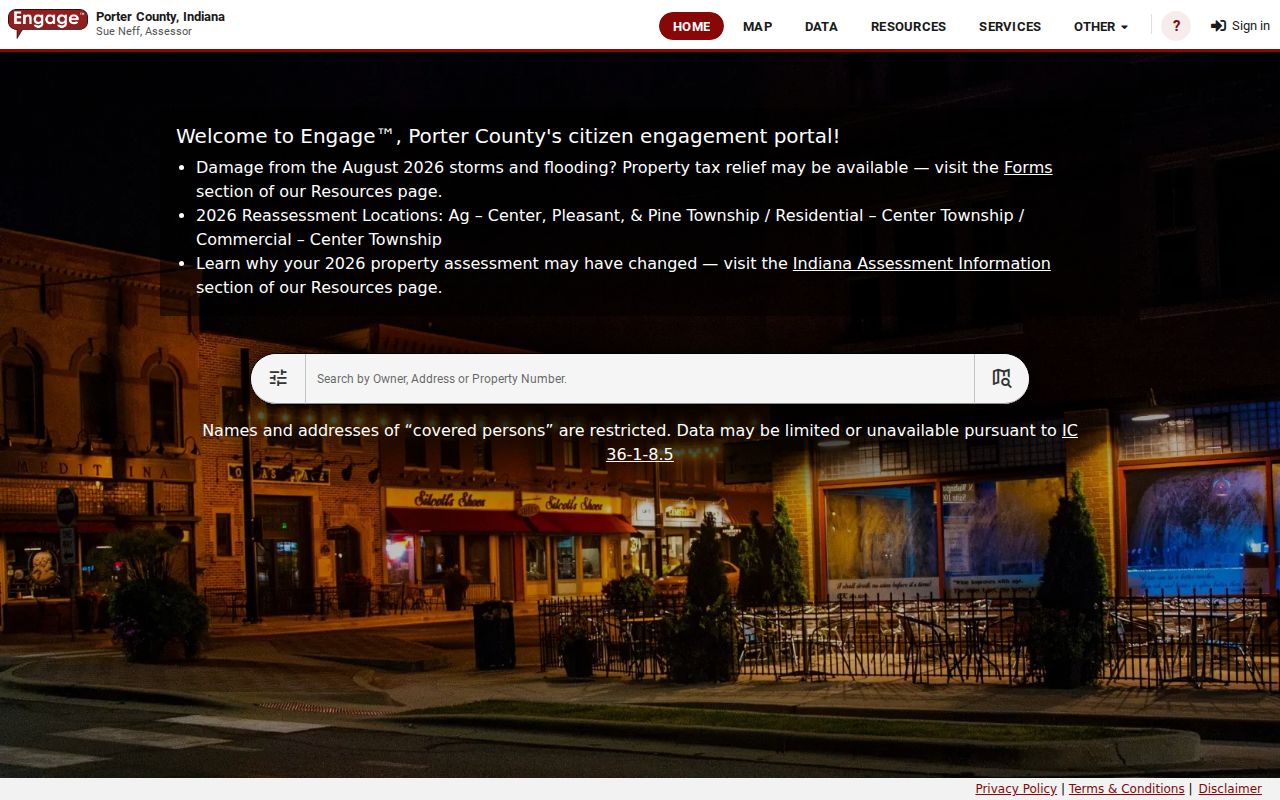
The county's portal result screen shows the point plainly. Keep both the owner label and the parcel identifier as you move toward deed confirmation.
Trace the Assessor Name to Porter County's Newest Deed
The Porter County Recorder opens three doors to its records. Direct Search, a free index reaching back to early 1978, runs about seven days behind recording. It shows no document images. Tapestry takes a pay-as-you-go approach. The county's current page prices a search at $8.75 with the image included, plus $1 per printed page. For frequent users, Laredo offers a subscription built on the same interface found at the Recorder's public workstations. Walk-in help is available too, at 155 Indiana Avenue, Suite 210, Valparaiso. Terminals and assistance with older materials await.
In XSoft, search the assessor's owner spelling as a grantee lead. Narrow the recording dates when you can. Then compare the legal description or parcel reference rather than trusting the street address alone. The newest matching conveyance names the grantee who took title. Keep timing in mind, though. A deed recorded in the past week may still be missing from Direct Search. An assessor label can lag behind for a while.
The Recorder's own record-search guide lays out the free, paid, subscription, and in-office routes. For the instrument itself, copy charges, or a full chain of title, turn to the dedicated Porter County deed records guide.
When a Porter County Owner Is an LLC, Trust, or Estate
Not every parcel names a person. Some list an LLC, a trust, or an estate instead. Each calls for a different follow-up. An Indiana business database entry for an LLC shows the entity record, filing details, and a registered-agent lead. The agent is not automatically the property owner, though. A trust may appear only as a trust name or trustee wording. Estate transfers are indexed under a decedent, a personal representative, an heir, an affidavit, a final decree, or a representative's deed.
For estate property, run the relevant names through the Recorder index. Probate context can come from Indiana MyCase and the Porter County Clerk Archives. Each system answers a different question. The business record describes an entity. The court file explains authority or proceedings. The recorded conveyance identifies the land and its grantee.
Three terms anchor any owner lookup. The owner of record is the name on an official roll or indexed conveyance. A grantee receives an interest in a deed. The situs address locates the parcel, while a mailing address routes tax correspondence and may sit elsewhere.
Where Porter County Property Ownership Appears
No single county screen answers every version of who owns a property. Compare sources by parcel identity, date, and legal description before drawing a conclusion.
| Official source | Ownership clue | Freshness and access |
|---|---|---|
| Assessor / XSoft roll | Owner Name attached to a Property ID | Free; dated dynamically, no official fixed owner-update interval found |
| Recorder deed index | Grantee and indexed instrument details | Free index from early 1978; stated seven-day delay |
| Indiana Business Search | Entity filings and registered-agent information | Free statewide entity lookup |
| County GIS service | Parcel geography and identifiers for cross-checking | Free layers; service metadata says updated every 24 hours |
None of these sources proves who occupies a building. A tax-mail destination may belong to an owner, a management office, a trustee, or another contact point. Keep identity and occupancy separate.
Protected Names and Addresses in Indiana Records
Public access has limits. The XSoft notice warns that names and addresses of covered persons may be restricted under Indiana Code 36-1-8.5. Indiana's Address Confidentiality Program adds another layer. It gives eligible participants a substitute address for public dealings. When a result comes back restricted, respect what the custodian lawfully displays. Don't try to rebuild the withheld address from other corners of the record.
The Indiana Access to Public Records Act, IC 5-14-3, covers requests for identifiable existing records. It never forces an office to create a report or to brush aside confidentiality law. If a field is hidden, ask the Assessor or Recorder a focused question. Let the office apply the exception that governs.
Use Porter County's Free Property Fraud Alert
Once you know who owns a property in Porter County, the Recorder can do more for you. The office offers a free Property Fraud Alert worth signing up for. It sends notice whenever a document is indexed under a name you register. That early nudge lets you pull the filing and inspect it yourself. Be clear about what the service is, though. It is notification only, not prevention, not insurance. It is no substitute for a title search or a finding of fraud. Register every name variant that matters. Then review any alert through the Recorder's office.
The county also posts a warning about deed solicitation letters. These target residents with offers of $99 document copies. Check the Recorder's official copy routes first. Paying a private solicitation should never be the default move.
Fix a Porter County Owner Search That Finds Nothing
An empty address result rarely means the parcel has no owner record. Start by trimming the search. Drop the apartment number and directional suffix. Then try just the street number plus a distinctive fragment of the street name. The exact punctuated parcel number is another reliable query. Properties near a city edge deserve extra care. Postal cities, GIS municipal boundaries, and township or district labels can disagree; compare each source independently. In XSoft, neighborhood and district labels are administrative clues, not proof of incorporation.
When a name search comes up empty in the Recorder index, vary the approach. Try surname spellings and entity variants, widen the recorded-date range, and search by document type. Direct Search demands at least one filled field. It also may miss a filing made within its stated seven-day delay. A courthouse workstation or Laredo gives the more current index view. Tapestry can supply the image you need to check the legal description.
Split and combined parcels add another wrinkle. Use GIS and current XSoft IDs to find the parent or successor parcel. Then follow the Recorder's references from there. Write down each query and the date you ran it. That habit separates a true no-result from a portal-timing or parcel-identity problem.
What a Porter County Ownership Lookup Cannot Settle
An assessor owner label answers who the tax roll carries, not who holds marketable title. It cannot establish occupancy or resolve competing interests. It is no substitute for a survey, either. Deeds may vest ownership in an LLC, a trust, an estate, or multiple grantees. Meanwhile, easements, restrictions, mortgages, releases, probate orders, and unrecorded claims all sit outside the label. Before a transaction or dispute, get the actual instrument. Then bring in qualified title or legal help.
Lawful use. Porter County owner information may support a purchase inquiry, deed-fraud check, estate matter, or boundary question. It must never be used to stalk, harass, intimidate, or harm anyone.