
What Porter County Deed Records Convey
The Porter County Recorder indexes deeds alongside other land instruments. Every deed names its grantor and grantee. It also carries a recording reference and a legal description. Its form and wording show what interest it purveys. So read it with the earlier instruments it references rather than stopping at the owner name in an index.
| Instrument form | Recorded function | Research clue |
|---|---|---|
| Warranty deed | Conveys the described interest with stated covenants. | Ordinary purchase or negotiated transfer. |
| Quitclaim deed | Conveys whatever interest the grantor has without equivalent warranties. | Family, entity, or corrective transfer. |
| Trustee's deed | Records a conveyance made by a trustee under authority. | Trust administration or authorized sale. |
| Personal representative's deed | Transfers estate property through an authorized representative. | Probate or estate chain. |
| Tax deed | Follows the statutory sale and redemption process. | Distressed history; different from a tax certificate. |
Not every recorded instrument is a purchase deed. Mortgages, assignments, releases, easements, plats, annexations, surveys, affidavits, final decrees, and liens can explain restrictions or signing authority just as well.
Three Porter County Recorder Search Channels
Porter County offers three search channels. Direct Search is the free index. The Recorder Record Searches page routes visitors to them, with Tapestry providing pay-as-you-go remote access to the index and images, and Laredo serving as the subscription system with real-time access and the same interface used at public Recorder workstations.
| Channel | Coverage and access | Best fit |
|---|---|---|
| Direct Search | Free; early 1978 forward; index only; seven-day delay | Names, dates, types, and references |
| Tapestry | 24/7 pay-as-you-go index and images | Occasional remote retrieval |
| Laredo | Subscription and real-time results | Frequent research |
| Recorder office | Public terminals, ledger, and microfilm | Older or difficult searches |
The county's official search-menu capture shows those routes together.
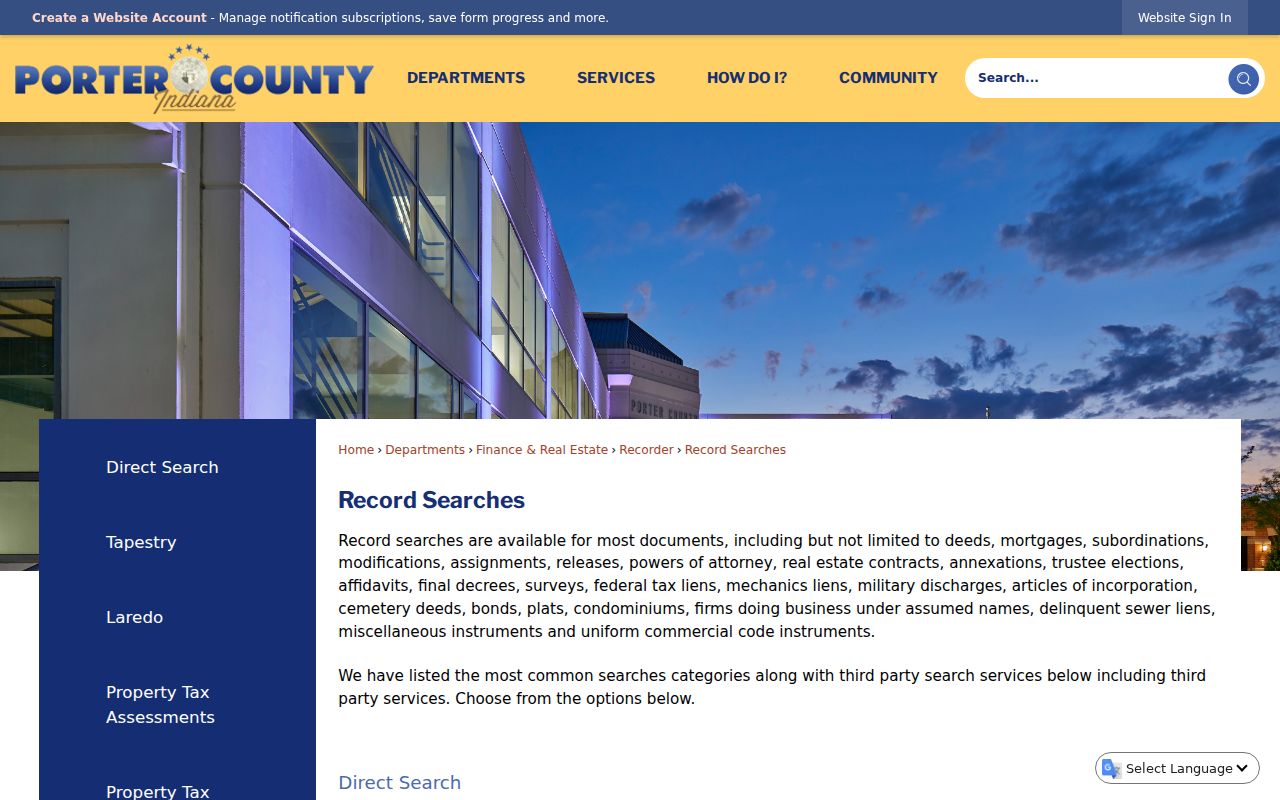
Select the route matching the needed date, image access, and search frequency.
Fields in Porter County Direct Search
The free Recorder Direct Search needs one field.
| Field | Requirement | Useful approach |
|---|---|---|
| Name | Optional if another field is used | Try prior/current owners, entity spellings, and variants. |
| Recorded Date From | Optional | Bracket an approximate transfer date. |
| Recorded Date To | Optional | Close the range around a known event. |
| Document Type | Optional | Separate deeds from mortgages, releases, plats, and other filings. |
The captured official landing page shows the index entry point.
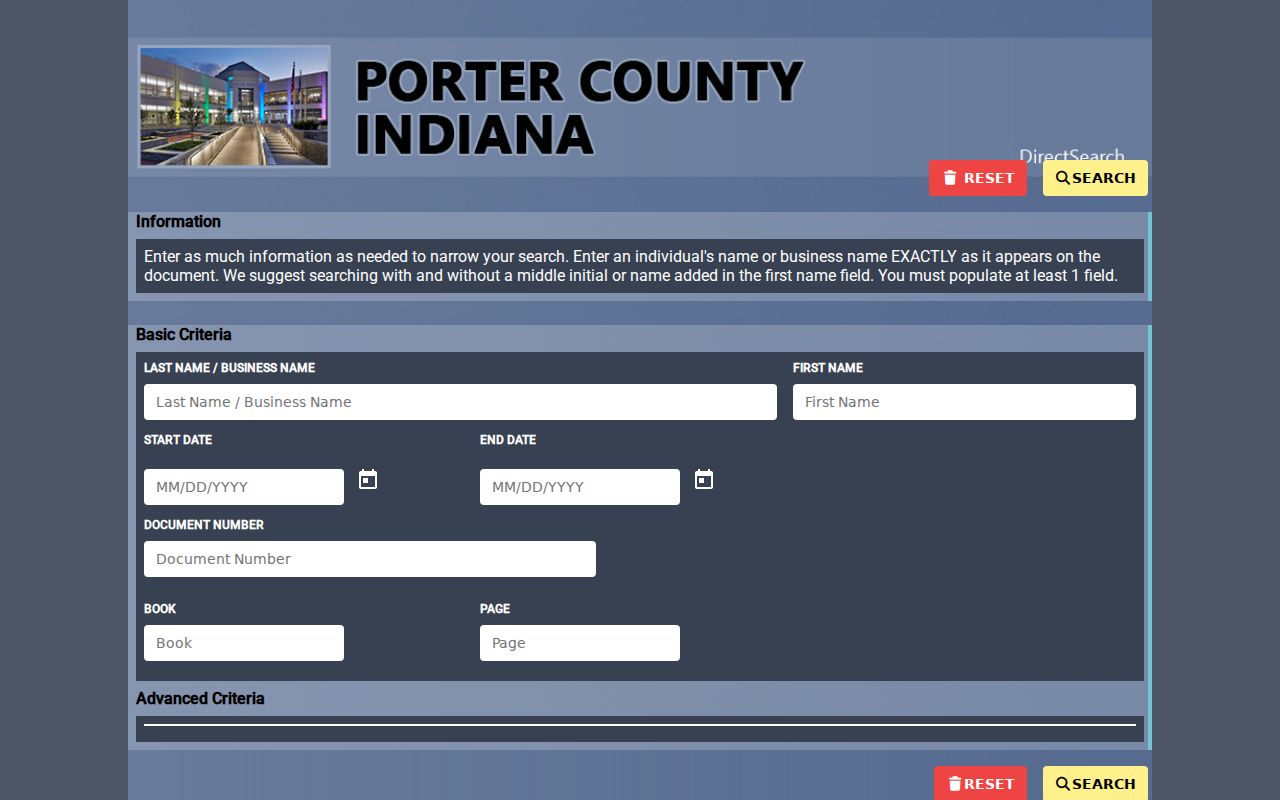
Direct Search shows no images. Save the instrument number or book and page, then move to an image channel or a copy request.
Follow Porter County's Grantor-Grantee Trail
A grantor conveys an interest. A grantee receives it. Start with the newest confirmed deed, note the grantee plus any prior reference, then search that grantee as a recipient around the acquisition date. To move backward, locate the deed by which the grantor acquired the same legal description and repeat the process.
- Get the assessment owner and parcel number through the Porter County property search.
- Search that name and likely transfer dates in Direct Search.
- Read the deed and capture instrument number, parties, legal description, and prior reference.
- Search the grantor's earlier acquisition, checking entity and personal-name variants.
- Repeat backward while logging every source.
- Grantor
- The party conveying the stated interest.
- Grantee
- The party receiving it.
- Chain of title
- The linked sequence of instruments affecting the parcel.
- Book/page or instrument number
- The reference used to retrieve one recorded document.
Chains often detour. A trust, estate, final decree, affidavit, or power of attorney may sit between two names, so read those instruments for signing authority instead of treating every name change as a market sale.
When Online Porter County Deeds Stop
Coverage claims differ by system. Direct Search cites early 1978, while an older county PDF describes online data and images from August 1980, so a missing early record calls for pre-1980 ledger and microfilm work rather than a conclusion that the conveyance never happened.
The Recorder sits at 155 Indiana Avenue, Suite 210, in Valparaiso, open weekdays from 8:30 a.m. to 4:30 p.m., with public terminals available. Call 219-465-3465 or email recorder@porterco.org. Mail requests work best with a recording number or book and page. Without one, the county recommends in-person research, a representative, or a title company.
The State Library Porter guide points to 1832–1854 tract-book entries, originals, and microfilm. The 1929 Hixson atlas helps with earlier names and geography. The Recorder still verifies the instrument.
Note: Historic “Dream City” plats include proposals never built, so verify them against later deeds, taxes, plats, and maps.
Porter County Deed Image and Copy Costs
The current Tapestry page lists $8.75 per index or image search, image included, plus $1 per printed page. An open account has a $25 monthly minimum. An older county PDF listed a lower historical price. Budget from the current webpage.
The Recorder fee schedule took effect January 1, 2021. It prices copies through 11×17 at $1 per page, larger copies at $5, and certification at $5. Confirm charges before paying. The county's deed-solicitation warning contrasts a $99 advertisement with the official $1-per-page alternative.
New-Filing Alerts in Porter County
The Recorder's free Property Fraud Alert notifies a subscriber whenever a document containing the subscribed name is recorded. It can flag an unexpected filing. It neither prevents recording nor establishes fraud.
Court judgments, state tax liens, bankruptcies, and documents never filed with the Recorder are expressly excluded. Subscribe under relevant personal and entity name variants. Then contact the office when an alert does not match an authorized transaction.
Cross-Check Legal Descriptions and Prior References
A shared surname or street address is not the strongest match. Legal land identity is. Compare lot, block, subdivision, unit, or metes-and-bounds language across consecutive deeds. Verify the parcel number too. Check the consideration, the recording date, and any prior-instrument references as well. A minor spelling difference may be harmless. A different lot or phase is not.
Plats and condominium declarations can carry common-area rights and phase details that the assessment card abbreviates, while easements, restrictions, and rights-of-way may sit elsewhere in the index. Marriage, entity conversions, trusts, and estates all change names. Affidavits and final decrees can supply the bridge, so search both human and entity names and classify an instrument only after reading it.
For a mortgage trail, locate the original mortgage, every assignment or modification, and the release. Never assume the first entry stayed unchanged. Mechanic's lien enforcement may require a second search in Indiana MyCase and the Clerk file. County guidance separates state tax warrants, county tax liens, federal liens, and Recorder filings by custodian. No single index gives an all-clear.
Obtain a Porter County Deed Copy
Remote copying starts with Direct Search. Once you locate the instrument there, pull the image through Tapestry when one is available. Heavy users should ask about a subscription option. Laredo is what the recorder offers for frequent work. In person, the courthouse provides public terminals, and staff can produce either a plain or certified copy. Mail requests work too. Include the exact recording reference, a description of the document, your return address, and the certification level you want. Call ahead to confirm the charge before sending payment.
Indiana's Access to Public Records Act, IC 5-14-3, lets anyone request an identifiable, nonexempt record. The record must not be otherwise accessible. The statute has limits, though. It does not force the Recorder to build a chain-of-title report. Nor must the office certify that no unrecorded interest exists. Timing matters as well. Land-conveyance routing stops at 3 p.m., and the counter takes no recordings after 4 p.m. Anyone hoping for a same-day Porter County deed filing should plan around those cutoffs.
A research log pays off. Track the query spelling, the date range, the document type, and the result reference for each parcel search. Add the image source and the date you retrieved it. That discipline makes a negative deed-records result reproducible. It also shows whether a later query reached broader names or newer index coverage than the first attempt.
Recorded, not guaranteed. Porter County deed records show indexed instruments, not a legal conclusion about ownership or priority; unrecorded interests and indexing delays may exist.