
Read Porter County Property Tax Records
No one office holds a complete account. The Assessor maintains parcel characteristics and sets the assessed value. The Auditor handles deductions and tax-distribution functions, the Treasurer bills and collects, and the Recorder keeps the deeds, which track a different name than the taxpayer label.
| Record field | Meaning | Official source |
|---|---|---|
| Property ID and district | Parcel identity and taxing geography | Assessor / tax list |
| Assessed value | Indiana market-value-in-use assessment by year | Assessor XSoft |
| Deductions | Approved amounts affecting taxable calculation | Auditor / bill |
| Tax year and payable year | Assessment period versus collection period | Treasurer bill |
| Spring and fall amounts | Installments, due fields, and penalties | Treasurer account |
| Delinquency or sale status | Unpaid-tax and certificate-sale process | Treasurer / sale notice |
The total can move for several reasons. A new valuation, a shifted deduction, a rate change, or added fees each moves a Porter County bill, so compare components across years rather than reading the total as a statement of market value.
Search the Porter County Tax List
The public Tax List takes district number, parcel number, name, tax year, or property address. Enter only one of those. The county warns that stacking too many fields can narrow the results. So a single parcel, name, or address usually works best. A parcel may have been split or combined in the last two years. In that case, try the owner's last name instead.
| Tax-list control | Format | Use |
|---|---|---|
| District number | Numeric district | Limit to taxing geography after confirming it. |
| Parcel number | Full Indiana format | Match an exact tax parcel. |
| Name | Taxpayer text | Find accounts when a parcel has changed. |
| Tax year | Year selector | Separate annual records. |
| Property address | Street text | Begin with a known situs. |
Research aid only. The tax-list portal says “Not for Official Use”; confirm a consequential balance, payment, or sale status directly with the Treasurer.
Look Up a Porter County Tax Bill
Use the county Property Tax Portal to reach bill information, payment tools, valuation, deductions, eNotices, and tax-sale links, and keep the parcel number from the XSoft assessor card beside the tax account. A familiar address can otherwise quietly merge two parcels. Check the digits every time.
- Find the parcel in XSoft by address, owner, or property number and capture the displayed data date.
- Search the Treasurer Tax List using one identifying field and compare the parcel, district, and address.
- Open the bill and distinguish tax year from payable year, then read spring and fall amounts and due status.
- Review deductions and assessed value; route deduction questions to the Auditor and payment issues to the Treasurer.
- If delinquent, check the official tax-sale material and confirm the current status before acting.
- Assessed value
- The county's value under Indiana's market-value-in-use system.
- Tax rate or levy
- The rate applied through the relevant taxing units.
- Deduction
- An approved reduction affecting the taxable calculation.
- Tax lien
- A claim arising from unpaid property taxes; it is not itself a tax deed.
Porter County Installments and Payment Routes
Spring taxes come due May 10 and fall taxes November 10 in a normal year. Weekends and holidays push the date to the next business day. The payment-options page explains bill timing, account search, and electronic payment choices. Check the current year's notices each cycle. Processing terms and charges can change.
A Treasurer sample bill displays separate parcel and duplicate numbers. It also shows the tax year paired with its payable year. The rest of the layout covers the property address, the taxpayer, and spring due and penalty fields. That layout is the lesson. Write the payable year down. Never treat the sample's personal details as evidence about another account.
Note: A taxpayer label helps locate an account but does not replace the newest recorded deed as evidence of ownership.
Why a Porter County Tax Bill Changed
A Porter County bill can shift for four reasons. The county's bill guide lists them: assessed valuation, deductions, tax rates, and fees. Compare the same field across years. A higher assessment says nothing about the rate. A deduction change can move the bill while the assessed value sits still.
Indiana's Department of Local Government Finance assesses property at 100% of market value in use, supported by annual trending and ratio studies. A recent sale can help. The Assessor cautions about foreclosure, tax sale, distress, and short-sale transactions. Those sales are not ordinarily representative. For weighing assessed value against sale price, the Porter County property value guide helps.
Porter's 2026–2030 Reassessment Cycle
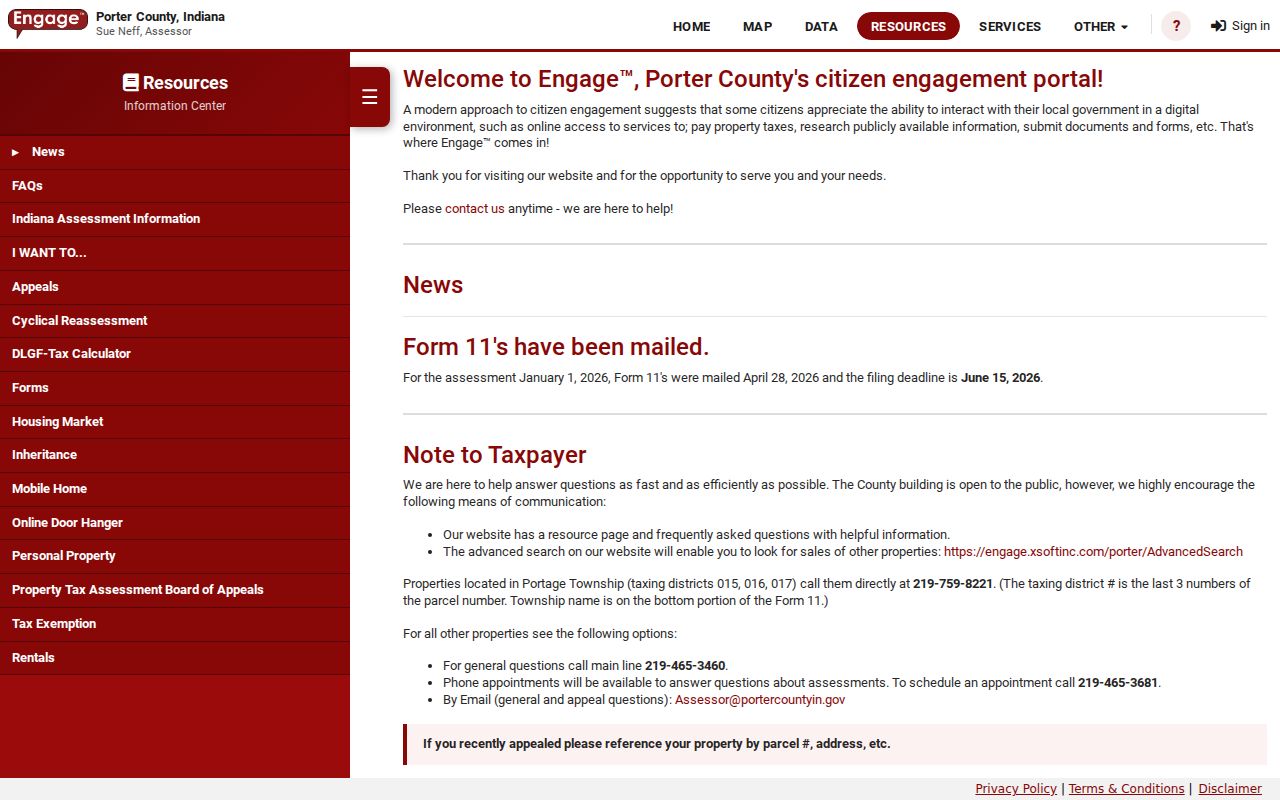
Porter County works on a four-year rhythm. Under the state cyclical-reassessment framework, the cycle opens July 1, 2026. It moves through roughly one-fourth of all parcels each year. The county's XSoft resources page names the 2026 inspection areas. The list covers Ag Center/Pleasant/Pine, Residential Center, and Commercial Center.
That same screen gathers the practical pieces in one place. Visitors can pull a property record card, read reassessment guidance, find Form 130, and review inspection details. They can also try the tax-estimate tools.
Never assume a countywide inspection year. Rely on the parcel's actual property record card and its Form 11 notice for what really happened.
Deductions, Damage, and Supporting Evidence
Tax deductions and disaster-related assessment relief run on separate tracks. The county portal shows where each deduction routes. Confirm eligibility and documentation with the Auditor or Assessor. Do not infer an exemption from an old bill. Keep dated copies of notices, photographs, appraisals, insurance material, and repair estimates where they apply.
Porter's August 2026 storm-relief material points potentially eligible owners toward Form 137R. The deadline is August 10, 2027. Relief is not guaranteed. Photographs, insurance information, appraisals, and repair estimates head the supporting list. Before filing, recheck the current details on the official XSoft resources page.
Tax Certificates Are Not Tax Deeds
A tax certificate sale is not a deed transfer. The tax certificate sales page walks through the delinquency and sale cycle. The buyer must still wait out redemption and later statutory steps. The official advertisement lists parcel, owner, minimum bid, sale information, and disclaimers. It guarantees nothing about condition, boundaries, access, or market value.
The 2025 advertisement offered a concrete list for that cycle. Status changes fast. Confirm against current Treasurer and sale-agent records. Payment, removal, or redemption can clear a parcel. For ownership, review any later recorded tax deed in Porter County deed records.
Offline Help for Porter County Tax Records
When a portal stalls, call the office that owns the field. The Assessor, at 155 Indiana Avenue, Suite 211 in Valparaiso, handles property cards, valuation, inspections, and Form 130 at 219-465-3460 or assessor@portercountyin.gov. The Auditor takes deduction questions. The Treasurer handles bills, payments, and delinquency status.
Before calling, gather the basics. Have the parcel number, duplicate number when shown, tax and payable years, portal date, and disputed field written down. For a nonexempt record not online, Indiana's Access to Public Records Act, IC 5-14-3, supports a focused request. Ask for the named record. Don't request a new valuation analysis.
Contest a Porter County Assessment
An appeal begins with paperwork you already have. Pull the Form 11 assessment notice and open the parcel in the county's XSoft system. The valuation, land and improvement details, sketch, and sales history sit together there. Look for a factual error or a valuation that misses the mark. Then gather comparable sales and evidence of the property's condition. File Form 130 through whichever county route suits you. XSoft lists three options. Mail it in, hand-deliver it to the Assessor, or submit through the portal after selecting the parcel. Filing does not guarantee a reduction.
Deadlines matter here. The Indiana citizen's guide sets the rules. Form 11 mailed before May 1 has an appeal deadline of June 15 of that year. If it goes out after April 30, the deadline moves. It shifts to June 15 of the year the tax statements are mailed. XSoft reported a Form 11 mailing of April 28, 2026. June 15, 2026 is the deadline for that cycle. Confirm your notice and the current calendar with the Assessor at 219-465-3460 or assessor@portercountyin.gov.
Appeal window. Treat the June 15 date as filing-critical and verify the applicable year from the Form 11 notice; a late submission can lose that cycle's review.